
The "Monviso Hazelnut"®
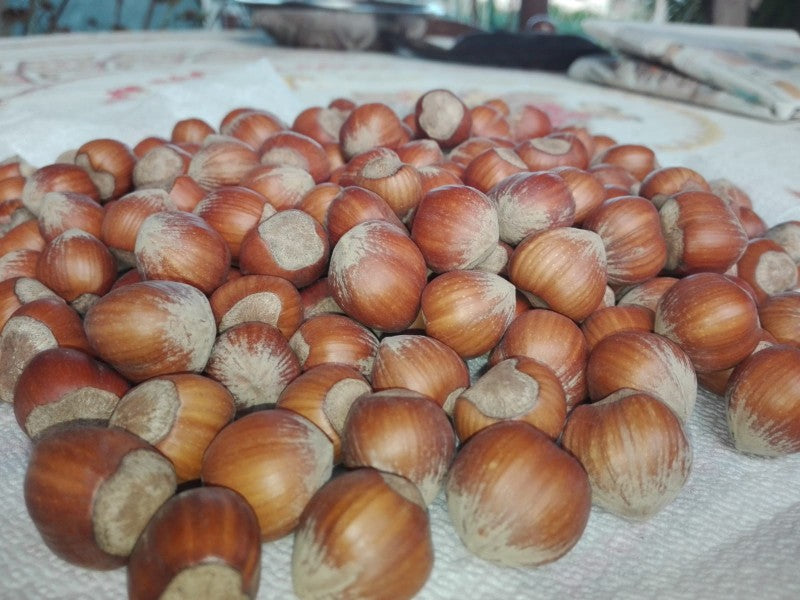
Agri-Geuna® hazelnuts are organically grown and certified and belong to the Tonda Gentile Trilobata variety
- Harvest: First ten days of August and late August
- Use: Raw shelled, roasted shelled, chopped or as flour
The hazelnut is the fruit of the hazel tree (Corylus avellana L.), a plant native to Asia Minor and typical of the Mediterranean basin, which grows wild in woodlands with a mild climate, known and cultivated by humans since antiquity.
The hazel tree has been cultivated since antiquity by the Greeks and Romans, who appreciated its properties; it is, in fact, one of the oldest plants cultivated by humans. For the Celts and in the beliefs of Piedmontese farmers, the hazel tree was a magical tree: stories and legends tell that magical creatures hid among the bushes.
Production today is concentrated in the countries bordering the Mediterranean: Turkey, Italy, Spain, Greece and France, but Turkey, with around 700 thousand tonnes, is the world's leading producer (70%); Italy is second, with 100-125 thousand tonnes, grown in only four regions: Campania, Lazio, Piedmont and Sicily.
The quality of Italian hazelnuts is internationally recognized. In particular, varieties such as Tonda delle Langhe (Piedmontese) and Tonda di Giffoni (Campanian) – both IGP-certified – represent examples of excellence.
More information
Hazelnuts grow in pairs or groups of three, covered by a long green membrane that must be removed before the shell can be cracked. The large, crunchy seed contained inside the woody shell, the actual cream-colored hazelnut, covered by a brownish membrane, is oily and sweet.
When hazelnuts reach full maturity, from mid-August to mid-September, they detach from the plant and fall to the ground. The harvest of the fruit takes place in several passes by hand as the ripe hazelnuts fall to the ground.
90% of hazelnut production is intended for the food industry, where it can be used in various forms depending on the type of product desired:
- whole: in pralines, nougats and chocolate bars;
- chopped: for snack, chocolate and nougat fillings, and for decorating cakes and ice cream;
- hazelnut paste: for making chocolate-based creams and ice cream;
- hazelnut flour: in biscuits and cakes.
The remaining 10% of hazelnuts is intended for direct consumption as in-shell nuts and roasted hazelnuts. Hazelnuts can be eaten fresh or roasted or frozen.
The fresh fruit is covered by a thin skin that is sometimes difficult to remove (simply put them in the oven for a few minutes and then rub them). It lasts for a few weeks, after which it becomes bitter, while in the shell it can last up to two years if kept in a dry place.
In the past, alternative uses for hazelnuts have also been proposed: in particular, their use for extracting high-quality oil (by cold-pressing the fruit), characterized by a sweet flavor and a delicate aftertaste.
Uses of hazelnuts
In addition to their classic use in the food industry, hazelnuts are a fruit characterized by countless properties and various uses.
Hazelnuts, like all nuts, are a highly energetic food capable of providing a high caloric intake (100 g provide approximately 655 Kcal that are easily absorbed; in fact, they are the oiliest seed and, at the same time, the most digestible).
The high energy value is due to their good fat content (64%), particularly monounsaturated fats (oleic acid is the highest, with values between 71 and 83% of total fatty acids) and linoleic acid. It has been widely demonstrated that oleic acid (also found in extra virgin olive oil) is an excellent “sweeper” of LDL cholesterol (bad cholesterol) and triglycerides, helping to provide a preventive and protective action against heart disease.
More information
As for the minor constituents, these vary greatly and are influenced by multiple factors such as variety, geographical origin, harvest period, and agricultural practices. Among these are Vitamin E, which has a higher content than olive oil: 35 mg/100g compared to 11 mg/100g. In addition to inhibiting free radicals and countering aging thanks to its antioxidant power, Vitamin E performs an important protective function against oxidative processes and strengthens capillary walls.
In addition to Vitamin E, hazelnuts contain good amounts of B vitamins (niacin and thiamine), in particular, hazelnuts are rich in Vitamin B6, which has a content between 0.55 and 0.88 mg/100g.
Finally, the nutritional value of hazelnuts is enhanced by a significant presence of trace elements (iron, copper, zinc and selenium) and other mineral compounds such as potassium, calcium, phosphorus and magnesium.
Some scientific evidence has suggested a beneficial effect of hazelnuts on human health:
- on cardiovascular diseases; one study has shown that regular consumption of nuts for 12 months (4 or more servings per week) is associated with a 30% reduction in the risk of death from vascular disease;
- on dyslipidemias; in particular, the antioxidant content and fatty acid composition would determine positive effects on cholesterol mobilization, reducing LDL and total cholesterol levels and increasing HDL (good cholesterol) levels;
- the high content of tocopherols (Vitamin E) and β-sitosterol also has a preventive effect on certain types of cancer (colon, prostate and breast).
Buy our organically grown hazelnuts online
Go to the shopHazelnut curiosities...
It can be said that nothing is wasted when it comes to hazelnuts; every part is used, from the trunk to the fruit.
The leaves are used in herbal medicine (as a natural anti-inflammatory) and steeped in hot water to make healthy herbal teas; placed in the freezer, they become a treatment capable of alleviating dark circles.
The oil extracted from the fruit is the basis of many creams because it absorbs easily and has soothing properties. It has a purifying effect, which is why it is recommended for oily skin, both as a cleanser (it is also found in soaps) and as a natural makeup remover.
The shells make excellent fuel and can be used to protect the base of outdoor plants from frost. Hazelwood produces a very fine charcoal, used in the manufacture of drawing charcoal.
Hazel rods are used by dowsers to search for water.
The "NOCCIOLA DEL MONVISO"®: the trilobate hazelnut cultivated at the foot of the "King of Stone"
The Agri-Geuna® hazelnut is organic and belongs to the Nocciola Tonda Gentile Trilobata variety, which is not only a typical and unique product of the Langhe but has also been cultivated, especially in recent years, in other areas of Piedmont, including ours. It is considered one of the best hazelnut varieties for processing and producing confectionery products.
The company's decision to undertake this cultivation is driven by a desire to return to the past: in the middle of the last century, many plots of land had been converted to this crop, but a lack of experience and documentation caused the project to fail, proving unprofitable. The hazel tree is, in fact, a perennial and delicate plant that must be managed and cared for in every minute detail throughout the year, from pruning and soil management to irrigation and harvesting.... and it is a very peculiar plant: it goes from being an impenetrable bush in summer to mere bare branches in winter.
Today, despite the adverse weather conditions the company has faced since its early days, it is a crop we strongly believe in because of all its potential.