
Zafferanetto, the saffron of Villaretto
Saffron is a spice obtained from the stigmas of the Crocus sativus flower, also known as true saffron
- Sowing: Mid-July
- Harvesting: With the first autumn chills, around mid/late October
- Use: Immerse the required stigmas in half a glass of water the day before use
A plant originally from Asia Minor and many countries in the Mediterranean basin, it was the Arabs who introduced it to Europe in the 7th century through Spain, where even today saffron cultivation is still widely practiced.
It is one of the oldest plants cultivated by man.
In Italy, the most extensive crops are found in the Marche, Abruzzo, Umbria, Tuscany, Basilicata, and Sardinia.
Saffron is harvested from the flowers of Crocus sativus, commonly known as the saffron bulb. Saffron flowers bloom in autumn and are harvested for the red pistils that we all know as "saffron pistils," from which the spice is extracted. Each bud produces three filaments called stigmas, which are carefully harvested by hand. Around mid-October, saffron flowers begin to bloom, and this flowering lasts about three weeks. This is followed by a period of intense flowering that lasts from two to six days. The flowers that appear during the night must be harvested at dawn the next day, no later than noon, to prevent the petals from wilting. It is best to harvest the flowers while they are still "sleeping" or closed to ensure high-quality saffron pistils.
Once the flowers have been harvested, the "floreting" phase begins, in which the stigmas or pistils are removed by hand with great care and attention. The white and yellow parts of the stigma are not removed, only the red ones.
More information
Immediately after floreting, drying, also known as roasting, takes place, which is done daily until the last pistils are dry. The harvested stigmas are dried at a temperature no higher than 60°C. After roasting, the pistils will have significantly reduced in size and weight, down to 80% of their original size. Five kilos of fresh stigmas are required to obtain just one kilo of dry pistils, of a vivid red color.
Saffron has always been renowned for its use in cooking. This ranges from appetizers to desserts, but the best combinations are with rice, shellfish, seafood, braised meats, and delicate sauces. Saffron enriches, colors, and enhances flavors.
Usually, this spice should be added at the end of cooking, otherwise it loses its flavor and aroma. Particular attention must also be paid to the dosage: 0.15 grams is sufficient for three/four people. Saffron can be used in powdered form (the classic saffron sachets) or even better, to keep the aroma unaltered, starting directly from the stigmas.
Buy our organic saffron online
Go to the shopSaffron is a spice, but not only...
In addition to making our dishes tasty and flavorful, saffron powder is a goldmine of valuable substances for the body: it contains over 150 volatile aromatic substances, which make up its essential oil. Furthermore, it is one of the foods richest in carotenoids (crocetine, α-crocin, picrocrocin and safranal), which give dishes their typical golden-yellow color, and vitamins A, B1 and B2. Thanks to its extremely rich composition of active ingredients, saffron is recognized for having multiple properties and uses:
- It promotes digestive functions and stimulates the digestive system by increasing the secretion of bile and gastric juices. For this reason, it is also widely used in the preparation of digestive liqueurs.
- Thanks to its high antioxidant content, it combats free radicals, which are responsible for accelerating cellular aging.
- Recently, saffron has also been proving to be a highly effective natural remedy for many modern lifestyle-related disorders such as stress, anxiety and depression. Recent studies have indeed highlighted that saffron has properties and benefits for the nervous system; in particular, one of its components, safranal, is able to positively influence brain activity.
- It is also used in cosmetic products thanks to its antioxidant properties: an excellent active ingredient in anti-aging products, but not only: its ability to fight free radicals makes it an ingredient that can be used in many body products. It is also a good anti-inflammatory, one of the most active in the natural world, and therefore proves useful when added to anti-sunburn ointments or gels that reduce bruising and swelling. It is a renowned soothing agent, useful in cases of irritation or particularly sensitive skin.
Another curiosity about saffron...
Not only are the highly valuable stigmas extracted from Crocus sativus, but in recent years saffron petals have also been introduced to the market, which are gently dried for use. They are a beautiful purple color and are used, for example, to garnish dishes. Furthermore, being edible, they have endless possibilities for use: they can be added to cookie dough, bread, batter for fried foods, desserts and puddings, and anywhere a touch of color is desired.
Our Zafferanetto
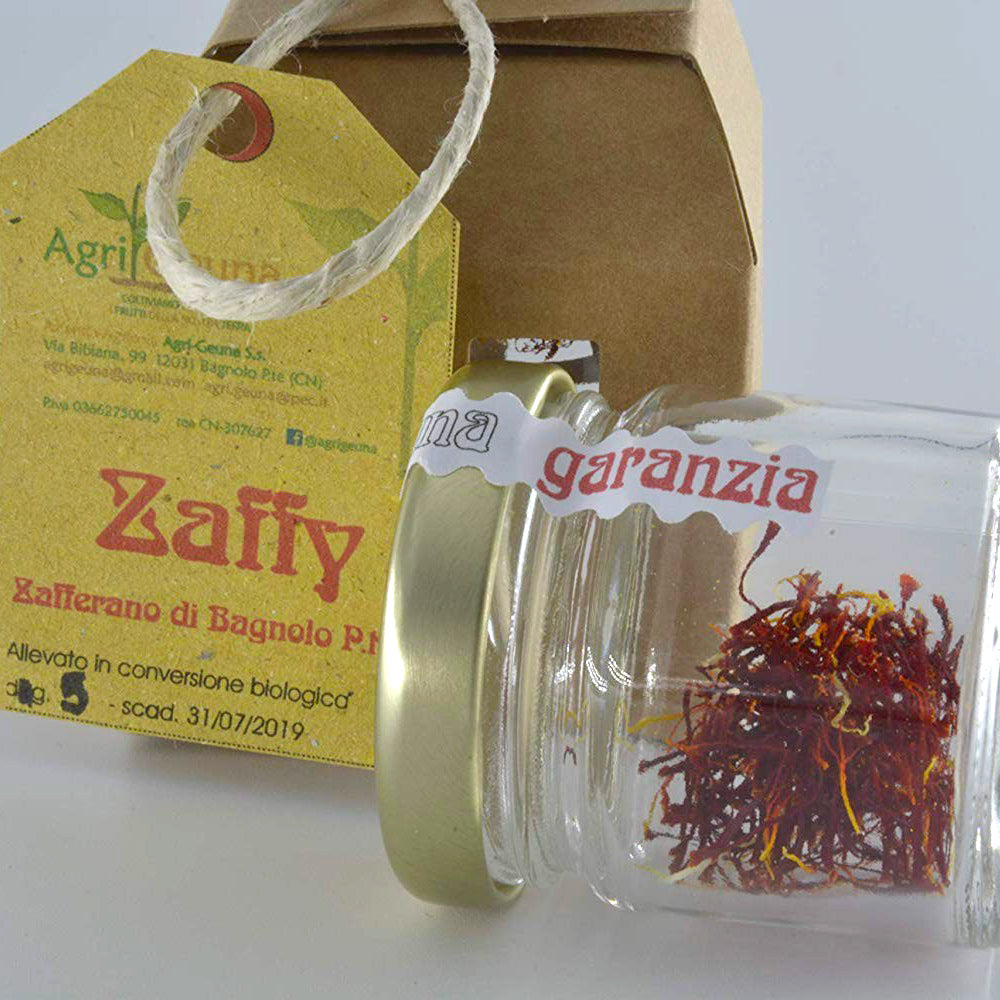
Two years ago, Agri-Geuna® introduced saffron cultivation. It is a unique and precious product, the result of hours and hours of work, from when the bulbs are planted by hand, one by one, to the time of harvest in early autumn. We have named it Zafferanetto, almost affectionately, because of the amount of time we dedicate to its care... It is an organic product of high quality: you only need to taste a classic saffron risotto prepared with Zafferanetto to notice its value...